Donor egg IVF is recommended when a woman cannot use her own eggs due to ovarian failure, poor ovarian reserve, or repeated IVF failure. Surrogacy is considered when a woman cannot carry a pregnancy to term. Both pathways are legally governed in India, under the ART (Regulation) Act 2021 and the Surrogacy (Regulation) Act 2021. These are two of the most emotionally significant decisions a couple can face in their fertility journey.
Dr. Pavan Bendale (M.B.B.S., DGO, DNB) offers donor egg and surrogacy guidance in Wakad from his fertility clinic in Tathawade, Pune. He serves couples from Wakad, Hinjewadi, Baner, Balewadi, Aundh, Ravet, Punawale, and across Pimpri-Chinchwad also providing full clinical and legal guidance before, during, and after the process.
Donor egg & Surrogacy are two of the most misunderstood, surrounded by misinformation about legal status, medical process, and what these options actually mean in practice. This page gives you clear, accurate answers.
What Is Donor Egg IVF and Who Needs It?
Donor egg IVF is a form of IVF treatment where the eggs used for fertilisation come from a screened, consenting donor rather than the intended mother.
The intended mother’s uterus still carries the pregnancy. She gestates and delivers the baby. Under Indian law, she is the legal mother.
The child shares genetics with the intended father and the egg donor. This is explained clearly at the first consultation so there are no open questions going into the process.
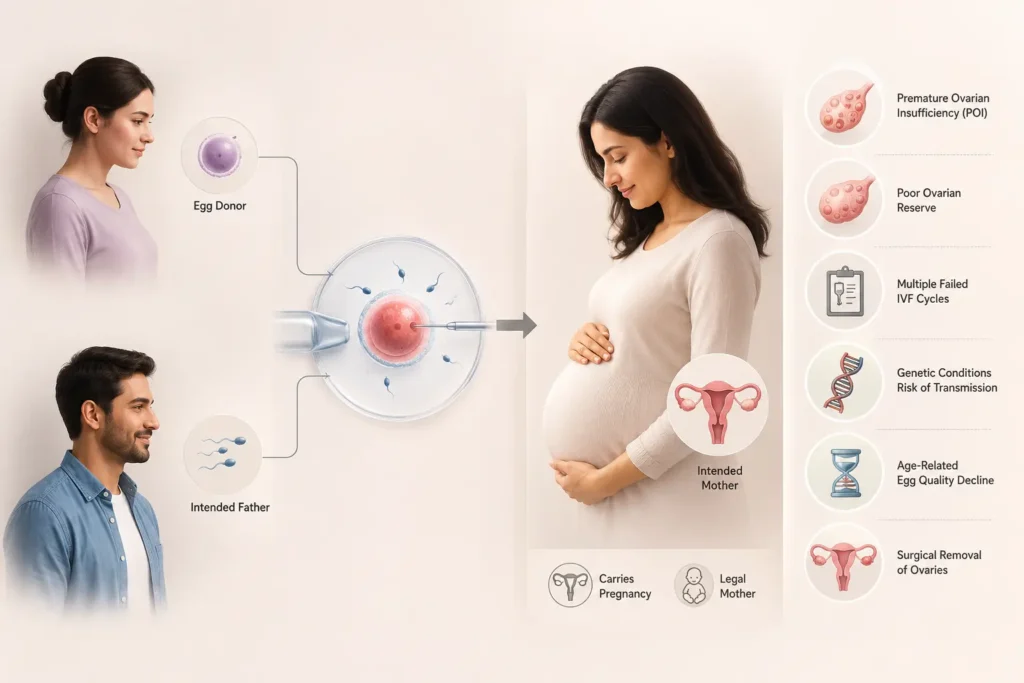
Donor egg IVF is not a last resort. It is the most appropriate first choice for specific clinical situations.
Dr. Pavan Bendale recommends it when:
- Premature ovarian insufficiency (POI) or early menopause has stopped egg production
- Poor ovarian reserve (very low AMH or antral follicle count) that makes own-egg IVF unlikely to succeed
- Multiple failed IVF cycles where poor egg quality was identified as the main contributing factor
- Genetic conditions in the mother that carry a high risk of transmission to the child
- Age-related decline in egg quality where success with own eggs is clinically very low
- Surgical removal of ovaries due to cancer or other medical conditions
For couples in Wakad, Pimpri-Chinchwad, and Hinjewadi who have already been through one or more failed IVF cycles, donor egg IVF often represents a genuine shift in outcome.
Not because the previous cycles were managed poorly. But because the underlying biology has changed, and the treatment approach needs to change with it.
How Is a Donor Selected?
Under the ART (Regulation) Act 2021, egg donors in India must be registered with a certified ART bank.
All donors are anonymous. The intended couple does not select a specific individual. Matching is done by the ART bank based on physical characteristics, blood group, and medical compatibility.
Every egg donor in a certified bank undergoes:
- Complete medical history and physical examination
- Hormonal and ovarian reserve testing (AMH, AFC)
- Infectious disease screening: HIV, Hepatitis B, Hepatitis C, and syphilis
- Genetic carrier screening for common heritable conditions
- Psychological assessment and informed consent
Dr. Pavan Bendale coordinates with certified ART banks to ensure donor eggs meet full regulatory and clinical standards.
No shortcuts. No unregistered sources. This is non-negotiable.
In cases where embryo-level genetic screening is appropriate, particularly for older intended mothers or couples with a genetic history, preimplantation genetic testing (PGT) is performed on embryos before transfer to further improve outcomes.
How Does Donor Egg IVF Work? A Step-by-Step Breakdown.

Step 1: Initial Assessment
The intended mother’s uterine health is assessed through sonography, hysteroscopy if indicated, and hormonal evaluation.
At the same time, the intended father undergoes a comprehensive semen analysis and DFI testing to confirm sperm quality before the cycle begins. Both evaluations run in parallel so no time is lost.
Step 2: Uterine Preparation
The intended mother’s uterine lining is prepared with hormonal medication, oestrogen and progesterone, to synchronise with the donor’s egg retrieval cycle.
This controlled preparation is what allows a woman with non-functioning ovaries to carry a pregnancy successfully.
Step 3: Egg Retrieval from Donor
The donor undergoes ovarian stimulation at the ART bank facility, followed by egg retrieval under short anaesthesia.
This process is entirely managed by the bank and does not involve the intended couple directly.
Step 4: Fertilisation and Embryo Culture
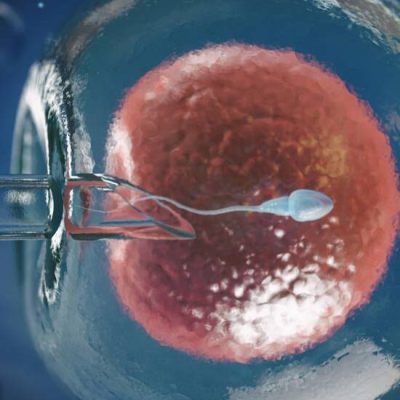
Retrieved donor eggs are fertilised with the intended father’s sperm in the laboratory. Embryos are cultured for 3 to 5 days.
Where indicated, PGT-A is carried out to screen embryos before transfer. If embryos are being stored for a future cycle, embryo vitrification is used to preserve them safely.
Step 5: Embryo Transfer
A single high-quality embryo is transferred into the prepared uterus of the intended mother.
The procedure is minimally invasive, takes about 15 to 20 minutes, and requires no anaesthesia. A pregnancy test is performed 14 days after transfer.
What Is Surrogacy? India’s Legal Framework Explained.

Surrogacy means another woman, known as the surrogate, carries and delivers a pregnancy on behalf of the intended couple.
In India, only altruistic surrogacy is legal.
Commercial surrogacy, where the surrogate is paid beyond documented medical expenses, was banned under the Surrogacy (Regulation) Act 2021.
This is one of the most frequently misunderstood aspects of surrogacy for couples in Pune and across Maharashtra. Many people come to Dr. Pavan Bendale having heard conflicting things about what is and is not allowed.
The legal position, simplified:
- Altruistic surrogacy, where the surrogate consents without financial incentive beyond covered medical costs, is legal
- Commercial surrogacy, which means paying a woman to be a surrogate, is a criminal offence in India
- The intended couple must have a medically certified reason why the woman cannot carry a pregnancy herself
- The surrogate must be between 25 and 35 years of age, must be married, and must already have at least one biological child of her own
- A certificate of eligibility and essentiality must be issued by the appropriate authority before any arrangement proceeds
The rules under the Surrogacy (Regulation) Act have also been amended to address the use of donor gametes in surrogacy arrangements.
This is an evolving regulatory space. Dr. Pavan Bendale provides guidance on current legal standing as a core part of every surrogacy consultation. For the most current statutory position, ICMR and the Ministry of Health remain the authoritative references.
Who Should Consider Surrogacy?
Surrogacy is not the first step. It is a specific medical pathway for specific clinical situations.
Dr. Pavan Bendale recommends surrogacy evaluation for couples where:
- The uterus is absent congenitally (Mayer-Rokitansky-Küster-Hauser syndrome) or following a hysterectomy
- Severe uterine abnormalities such as extensive intrauterine adhesions (Asherman’s syndrome) that cannot be corrected surgically
- Repeated implantation failure despite high-quality embryos and optimal uterine preparation
- Medical conditions that make pregnancy life-threatening: severe cardiac disease, certain autoimmune conditions, or renal disease
- Recurrent pregnancy loss with a confirmed uterine cause
Surrogacy is evaluated only after other options have been considered or attempted, including corrective surgery, advanced embryo preparation, or targeted uterine treatment.
It is not shortcut advice. It is considered, specific clinical direction based on the individual case.
“We were told surrogacy was our only option at two other clinics, without anyone explaining why or what the legal process involves. Dr. Pavan Bendale spent the entire first appointment going through our history, what the law says, and what our options actually are. That clarity alone changed how we approached this.”
— Verified patient, Google Reviews
Dr. Pavan Bendale’s Approach: Guidance First, Treatment Second
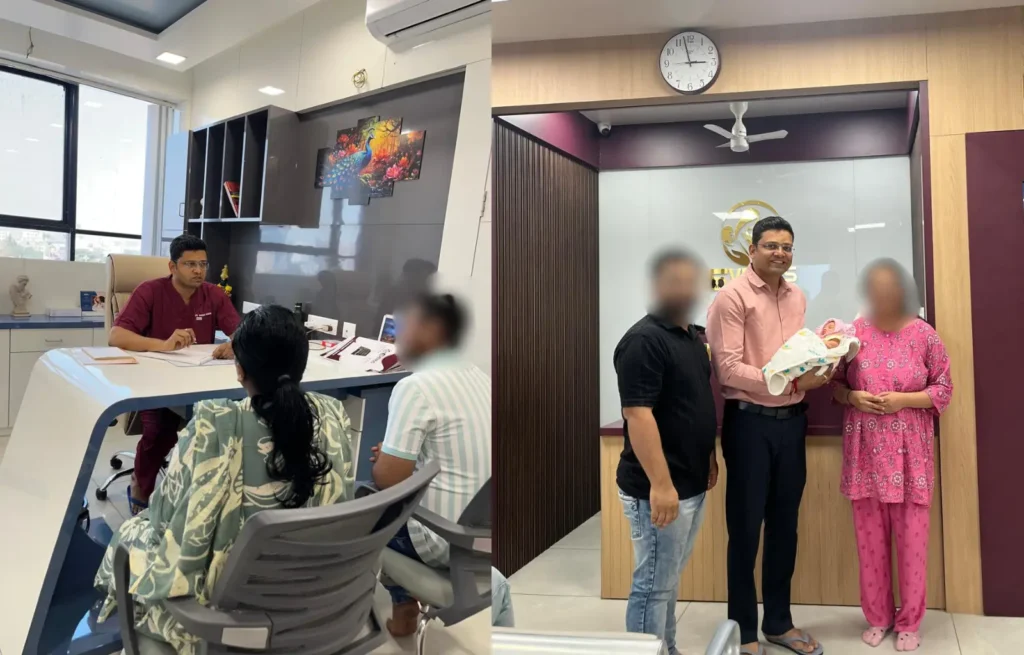
Donor egg and surrogacy in Wakad under Dr. Pavan Bendale begins with a full consultation, not a treatment plan.
The first appointment covers your medical history, a review of prior treatment outcomes, a discussion of legal eligibility, and an honest assessment of which pathway is appropriate and why.
Dr. Pavan Bendale does not recommend donor egg IVF or surrogacy unless the clinical case genuinely calls for it.
Couples who may still achieve pregnancy with their own gametes through IVF or IUI are guided toward those options first. The goal is the right outcome, not the most complex treatment.
For couples from Balewadi, Sus Road, Ravet, Punawale, Chinchwad, and across the Pimpri-Chinchwad Municipal Corporation area, the clinic in Tathawade is among the closest fertility practices offering this level of specialist-led guidance for both donor egg and surrogacy pathways.
Dr. Pavan Bendale’s clinical approach is informed by guidelines from international bodies including ASRM, ESHRE, and FOGSI, alongside ICMR standards applicable to Indian practice.
Frequently Asked Questions
Is donor egg IVF legal in India?
Yes. Donor egg IVF is fully legal in India and is regulated under the ART (Regulation) Act 2021.
Donors must be registered with a certified ART bank and the process must be carried out at a registered ART clinic. Dr. Pavan Bendale’s practice operates fully within these requirements.
Will the child born from donor egg IVF be legally ours?
Yes. Under Indian law, the intended mother who carries and delivers the baby is the legal mother. The child is legally the couple’s child.
The egg donor has no legal rights or obligations toward the child.
Can we choose the egg donor?
Under Indian law, egg donation is anonymous. Couples do not select a specific donor by identity.
Matching is done by the certified ART bank based on physical and medical compatibility, and donor identity is not disclosed at any stage.
How is surrogacy different from donor egg IVF?
In donor egg IVF, the intended mother carries the pregnancy in her own uterus. Another woman’s eggs are used, but the intended mother gestates and delivers the baby.
In surrogacy, another woman carries the pregnancy entirely. These are two distinct pathways, for two different clinical situations.
Is commercial surrogacy still available in India?
No. Commercial surrogacy was banned by the Surrogacy (Regulation) Act 2021.
Only altruistic surrogacy is legally permitted, meaning no financial payment beyond documented medical expenses can be made to the surrogate. Anyone offering paid surrogacy arrangements in India is operating outside the law.
How long does the donor egg IVF process take?
From initial assessment to embryo transfer, the process typically takes 6 to 10 weeks.
This depends on donor availability through the ART bank and the time needed to prepare the intended mother’s uterine lining. Dr. Pavan Bendale discusses realistic timelines at the first consultation.
What are the chances of success with donor eggs?
Success rates with donor eggs are generally higher than with own eggs in poor-reserve cases, because donor eggs come from young, healthy, screened women.
However, outcomes depend on multiple factors: uterine health, embryo quality, and the clinical protocol used. Dr. Pavan Bendale gives you a realistic picture based on your specific case, not a generic number.
We are from Hinjewadi. Is the clinic accessible from there?
Yes. The clinic is in Tathawade, a short drive from Hinjewadi Phase 1, 2, and 3.
Couples from Wakad, Hinjewadi, Baner, Balewadi, Aundh, and Pimpri-Chinchwad regularly consult here. The click here for directions and appointment details.
“After three years and two IVF failures, we were exhausted. Dr. Pavan Bendale was the first doctor who sat with us, explained what donor egg IVF would look like for our situation specifically, and what we could realistically expect. We are now 14 weeks pregnant.”
— Verified patient, Google Reviews
The Next Step Is a Conversation, Not a Commitment
If you are exploring donor egg and surrogacy in Wakad, the first appointment is a consultation, not a treatment session.
You will leave with a clear understanding of which pathway fits your situation, what the process involves clinically and legally, and what realistic outcomes look like.
Learn more about Dr. Pavan Bendale’s background and qualifications before your visit, or reach out directly to book a consultation.
Dr. Pavan Bendale, Fertility Specialist, Wakad
301, 3rd Floor, Darekar Heights, Dange Chowk Road, Bhumkar Chowk Rd, Opp. Pandit Petrol Pump, Tathawade, Pune 411033
Call / WhatsApp: 07840950737